
Summary Of Habit 3 of 7 Habits
The Habit 3 Covey talks about is the prioritization of tasks. Covey describes the importance of keeping your priority things on the top. He explains that you should be able to identify the tasks that are important and prioritize them above all. With so much happening around in your surroundings, there are chances that you miss the important ones. This is why it is vital that you create a list of high priority goals and cater to them according to their importance.
In this habit, he said “first things” are basically all those things that value the most in your life. So, you should manage your schedule according to your priorities to get all essential things done on time.
If you have mastered the first two habits described by Stephen Covey, now it’s time to move on to habit 3 Put First Things First. This habit is about setting your priorities and accomplishing the first and second habits, namely, Habit 1 - Be Proactive and Habit 2 - Begin with the End in Mind.
It demonstrates how to spend more time in Quadrant II, which includes important activities, tasks that help you live a balanced life, and avoid the burden of urgent tasks. Urgent matters require immediate attention and often dictate our reactions, whereas important tasks that aren’t urgent require more proactive efforts and discipline to prioritize effectively.
The first challenge that Stephen Covey teaches about the 7 habits of highly effective people habit 3 is to answer the following two questions:
-
What single thing that you should be doing regularly to make a big change in your life?
-
What things in your professional or personal life would lead to similar results?
Before moving on to the online resources, try giving these two questions a thought, even if you are not ready to provide the answers.
Ready?
Put First Things First
Put first things first — a phrase that’s easier said than done. In this busy world, it’s very easy to lose sight of your goals.
And because it’s impossible to have just one task on your list, you need to keep your ducks in a row. So, how do you do this?
There are different tools to help you put things first. But perhaps the best method is the Eisenhower Matrix.
The matrix was later popularized by the late Stephen Covey in his best-selling book “The 7 Habits of Highly Effective People.”
Covey integrated ways to resolve professional and personal difficulties, thus the division of daily activities into four quadrants.
He incorporated this concept into what he called the third habit, which means to put things first.
Putting first things first encourages you to adopt a way of life where life should be celebrated without compromising your responsibilities.
What is the Third Habit
To fully understand the third habit, you need to revisit Stephen Covey’s first and second habits.
The first habit talks about being proactive. Going after what you want in life. Being responsible for your behavior, result and growth. Knowing that you are accountable for the things you do.
The second habit is, to begin with the end in mind. This means being able to envision the things you want in life. Like a building that needs a blueprint, you also need to contemplate on the things that you want to achieve.
Now, this is where the third habit comes in. Putting first things first perfectly complements Habit 1 (be proactive) and Habit 2 (begin with an end in mind).
So, what does Habit 3 mean? It means to act on your ideas, vision, and goals. Now that you have established a vision and taken responsibility for your life, it’s time to act.
However, the third habit is not focused on a single goal. On the contrary, it’s geared toward long-term goals that reap tremendous benefits.
Habit 3 is said to be the key to fulfillment. If you put more weight on the things that matter and make it a habit to live a life of value, you will have achieved greatness.
How to Put First Things First
The secret to weekly planning is to make priorities. It’s clear that working on your priorities with the bigger picture in mind (quadrant 2 tasks) contributes to your personal and professional growth. Everything else will follow.
A perfect example is the big rock-small rock principle. Imagine your life is a jar. If you put in the big rocks first, the smaller rocks will settle in the cracks, allowing them to fit into the jar. It’s pretty much like how urgent things work their way through major tasks in real life.
To illustrate, here’s a run through of a day with the “first things first” principle in mind. Note that this involves moving tasks from quadrant 1 to quadrant 2.
First, you determine the bigger goals you want to achieve in life. For example:
- I want to be more focused
- I want to improve my physical health
- I want to become the best version of myself
After determining your goals, you start your day with the “big rocks” in mind. Following our example above, you will:
- Practice meditation after waking up. Starting your day right will determine how the rest of your day will go. Meditation creates calmness and clarity, which makes you more productive.
- After meditating, it’s time to do some exercises to improve your physical health. This is important for you to feel alert and active throughout the day.
- To become the best version of yourself, you’d want to dress up accordingly and present yourself neatly. This boosts your confidence and self-esteem.
The simple example shows how the small rocks will adjust if you prioritize your big rocks first.
This means focusing on your Q2 tasks — tasks that are important but not urgent — rather than the urgent and important tasks (Q1).
The irony of this is when you don’t follow through on your Q2 tasks, they would eventually turn into Q1 tasks.
For instance, if you forget to exercise regularly, sooner or later you’ll feel unhealthy until an emergency situation will force you to try exercising again.
Unless you want a constant crisis in your life, you must make it a habit to move quadrant 1 tasks to quadrant 2 tasks. Such is the importance of prioritizing your tasks.
What Does ‘Put First Things First’ Mean?
“Put First Things First” is a principle that emphasizes the importance of prioritizing tasks and activities based on their urgency and importance. It means organizing and executing around your most important priorities, focusing on what is truly important to you, and managing your time effectively to achieve your personal and professional goals. In a business context, this approach helps leaders and teams focus on core objectives, driving business growth and organizational success.
In essence, “Put First Things First” is about making conscious decisions about how to spend your time and energy, ensuring that you are allocating your resources to the most critical tasks and activities that align with your personal mission and values. This principle is closely related to effective personal management, which involves being proactive, setting clear goals, and managing your time and resources to achieve those goals. An effective manager exemplifies this by prioritizing important tasks, leading by example, and ensuring that their team focuses on what truly matters.
By putting first things first, you can make a tremendous positive difference in your personal and professional life. It allows you to focus on the big rocks, the high-priority tasks that contribute to your mission, values, and goals, and avoid getting bogged down by urgent but less important matters. This principle is essential for achieving effective management, which is a function of your independent will and ability to make decisions and choices that align with your values and goals. In business, this strategic prioritization leads to better organizational management and long-term results.
In the context of time management, “Put First Things First” means understanding the four quadrants of time management and prioritizing tasks accordingly. Quadrant II, which includes important but not urgent activities, is the heart of effective personal management, and it requires more initiative and proactivity to tackle important matters that are not urgent. By focusing on Quadrant II activities, you can make progress towards your long-term goals and create a sense of balance and fulfillment in your life.
In contrast, Quadrant IV, which includes not urgent and not important activities, is a waste of time and can lead to procrastination and a sense of stagnation. By avoiding Quadrant IV activities and focusing on the first things, you can achieve a sense of purpose and direction, and make progress towards your personal and professional goals.
In summary, “Put First Things First” is a principle that emphasizes the importance of prioritizing tasks and activities based on their urgency and importance, and managing your time effectively to achieve your personal and professional goals. By putting first things first, you can make a tremendous positive difference in your life, achieve effective management, and create a sense of balance and fulfillment.
The Four Quadrants of Time Management
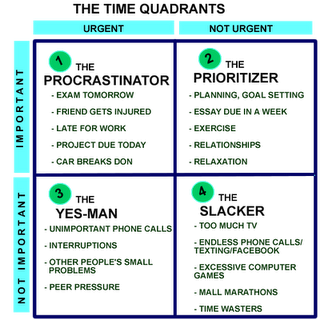
Understanding the paradigm of time management promoted by Stephen Covey is vital if you want to master the 7 habits. I suggest keeping this image or any other representation of the four-time quadrants in a place where you can see it.
What is the Connection Between Habit 1 & 2 and Habit 3?
When studying the 7 habits, it’s always important to see them as a whole rather than separate principles. The 7 habits are interdependent, especially the first three are closely related to each other as they help you achieve personal victory and independence.
Habit 3 helps manage external influences and stay focused on personal values by addressing the forces surrounding individuals and ensuring that their actions align with their principles.
Reading about the habit 3 of 7 habits is an excellent occasion to review the first two and understand how the three are intimately linked to each other:
-
Habit 1 teaches you that you are the master of your life, you are in charge, and you are responsible for what happens to you.
-
Habit 2 appeals to your imagination and encourages you to see with the eyes of the mind — what is not yet possible. It helps you to create a vision of what you could become.
-
Habit 3 is putting into practice what you have learned until now by implementing effective management of your own personality. It will help you spend more time in Quadrant II and understand why dealing with priorities, first of all, helps us achieve better results and maintain the balance between productivity and production capacity.
How Can the Habit 3 First Things First Change My Life?
Let’s go for a real-life example. For instance, you may be tempted to spend time browsing the Internet tonight and end up going to bed tired and bored. This kind of activity belongs to Quadrant IV – where unimportant and not urgent activities are found.
Imagine a ringing phone; it demands immediate attention and illustrates the urgency of Quadrant I tasks. The harm you cause on yourself for the long term by staying in Quadrant IV can be bigger.
Wasting time instead of doing something good for your body and your mind, like going to the gym or reading a good book, will result in deteriorated health and reduced production capacity.
This means that at some point you will be pushed to Quadrant I, where urgent and important activities are included. You may have to deal with an acute health problem or you may end up lacking energy so much that you will postpone your work until it becomes urgent and you have to deal with it now.

Overcoming Obstacles to Putting First Things First
Even with the best intentions, putting first things first can be challenging in both your personal and professional life. One of the biggest obstacles is the natural tendency to focus on urgent tasks—those ringing phones, last-minute emails, and immediate requests that demand your attention. While these urgent matters often feel important, they can distract you from your most important priorities and high priority goals, leading to a reactive approach to time management rather than a proactive one.
To overcome this, it’s essential to use the Time Management Matrix, also known as the Eisenhower Matrix, which helps you categorize your tasks into four quadrants based on urgency and importance. By consciously choosing to spend more time in Quadrant II—where important but not urgent tasks live—you can make a tremendous positive difference in your life. This shift means organizing your day around activities that support your long term goals, personal mission, and vision, rather than letting the forces surrounding you dictate your actions moment by moment.
Another common obstacle is a lack of clarity about what truly matters. Without a clear sense of your values, principles, and most important things, it’s easy to let less important tasks fill your schedule. Effective personal management starts with defining your personal mission and identifying your most important priorities. Leadership decides what the first things are, but effective management is about executing those priorities, moment by moment, with discipline and independent will.
Distractions and the temptation to spend too much time on non-essential activities can also derail your focus. Developing the habit of saying no to urgent activities that don’t align with your high priority goals is crucial. This requires discipline and the ability to manage your time and resources according to your values and vision. By regularly asking yourself, “What one thing could I do in my personal life to make a tremendous positive difference?” and “What one thing in my professional life would bring similar results?” you can ensure your actions align with your most important priorities.
Tools like the Eisenhower Matrix, digital planners, and regular reflection can help you stay on track. Remember, effective management is about putting first things first—not just reacting to what’s urgent, but proactively focusing on what’s important. By mastering Habit 3 Put First Things First, you’ll develop the habits of highly effective people, increase your personal effectiveness, and achieve greater success and fulfillment in all areas of your life.
Software to Help You Focus on Your Priorities
Have you ever tried getting an accurate picture of what occupies your time throughout the day? I’ve been doing an interesting experiment in which I use an app to determine my daily computer and Internet usage habits.
RescueTime
RescueTime delivers a comprehensive analysis of your digital life and identifies those habits that ruin your effectiveness. You just need to install the app and it will run in the background on your computer and mobile devices.

It tracks time spent on applications and websites and then produces detailed reports about your daily activity. Now you will know for sure if you are interrupting your work 50 times a day to check your social media accounts or you are spending a long time on websites providing low-quality entertainment.
Pomodoro Timer
After identifying those interruptions in your daily workflow or important activities, you can apply a very simple yet effective method for eliminating them – the Pomodoro Timer.
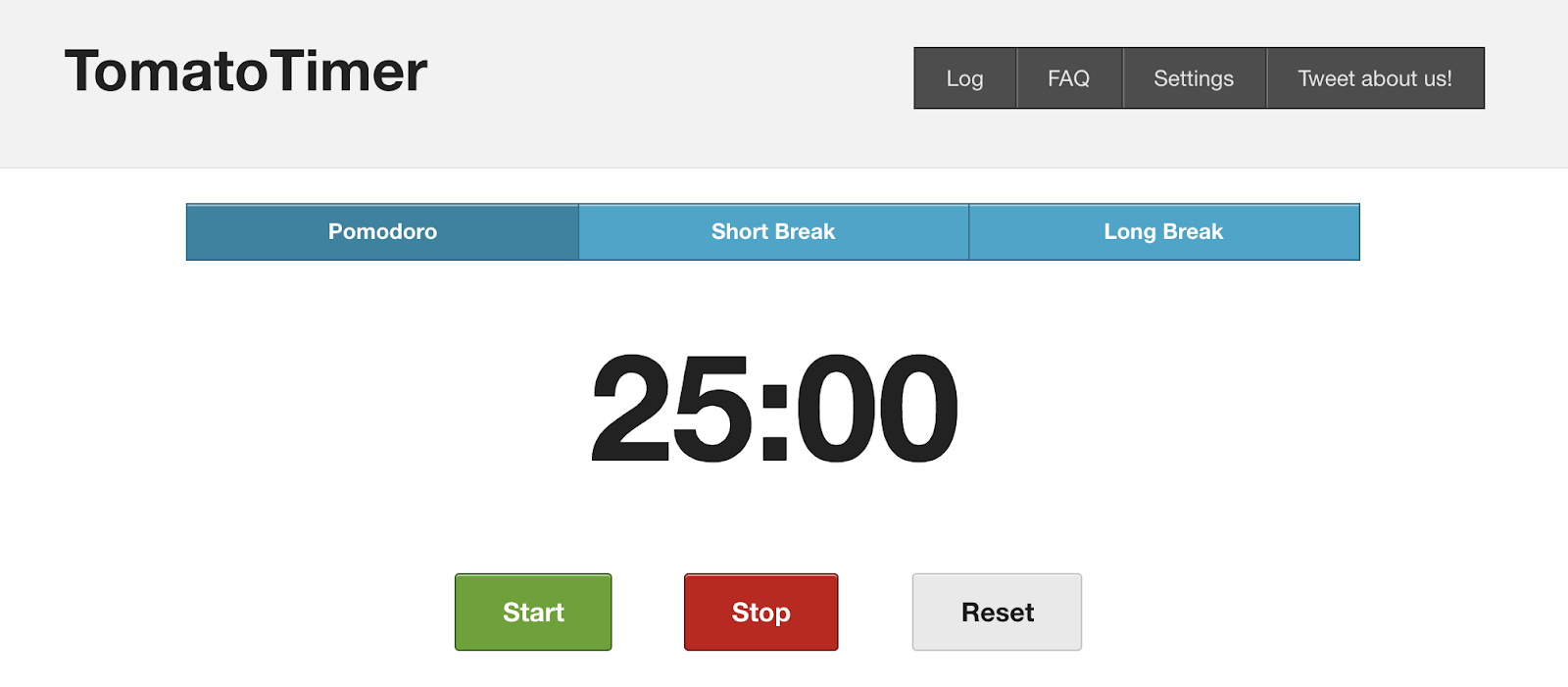
There are many apps based on this Italian time management method, but in order to familiarize yourself with it, you can try this simple website with pomodoro timer that doesn’t require you to install any piece of software on your computer.
In short, the idea is to break down your work into intervals, traditionally 25 minutes in length, and separate them by short breaks. During the 25 minute intervals, you will ignore any possible interruption – an excellent exercise for getting that stay-in-Quadrant II mentality.
Going back to the two questions formulated by Stephen Covey, you may find it easier to provide some good answers.
Week Plan
RescueTime and the Pomodoro Timer are great productivity tools. The former is perfect for tracking your productivity at work while the latter keeps you focused on specific tasks.
But if you want to take things to the next level — from productivity to effectiveness, then you need more than just a productivity app. Maybe Week Plan is your answer. Among many apps that boost productivity, the platform tops the charts.
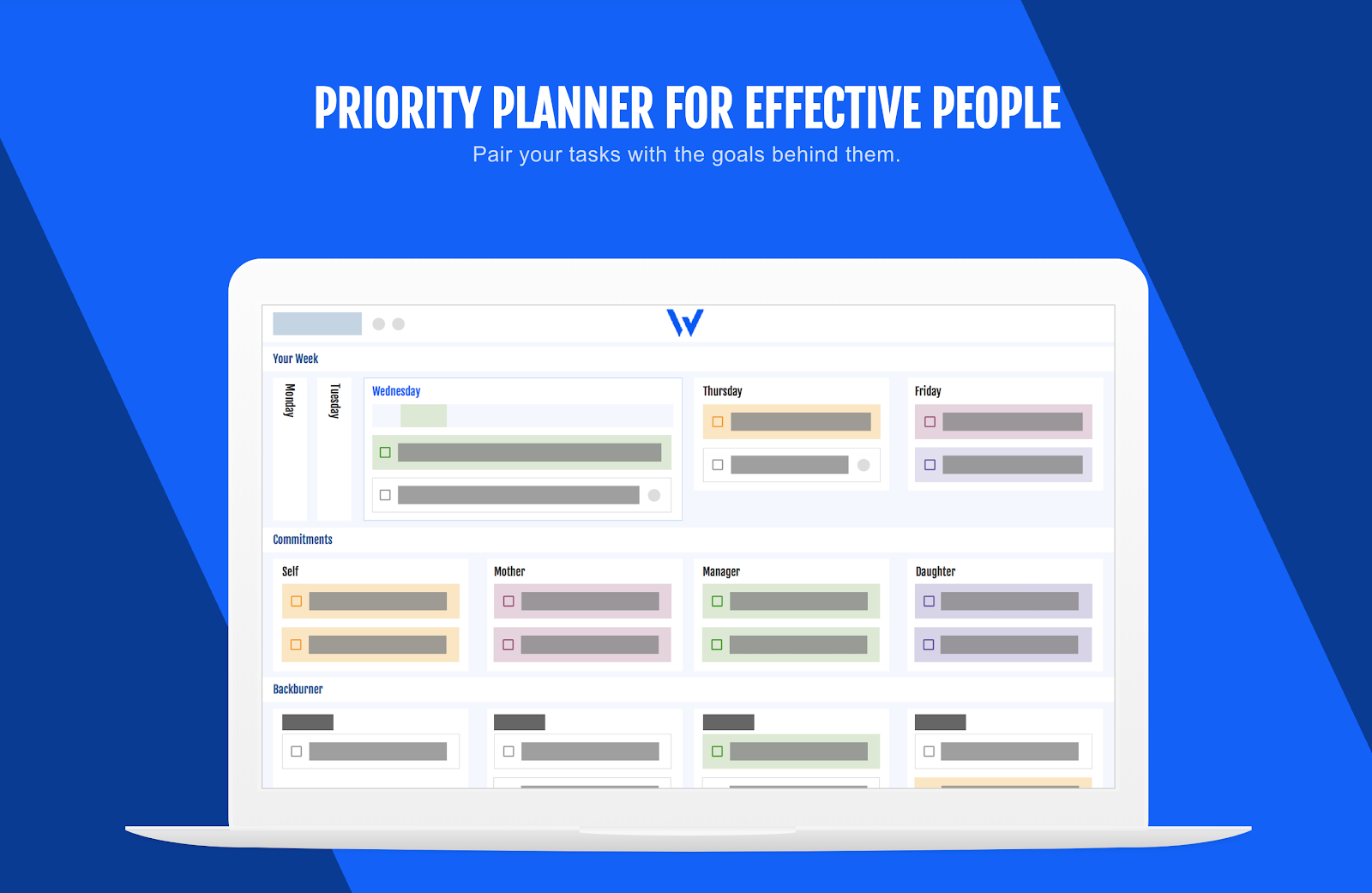
Week Plan is a priority planner that helps you do the right things — the things that truly matter. It lets you prioritize tasks according to urgency and importance while allowing you to set high-impact tasks (HITs).
But Week Plan is not just a productivity Swiss Army Knife, it also has a vision planner, goal tracker, journal, roles management, calendars, and more. Check out the full features:
-
Quadrant View Prioritization Tool (Eisenhower Matrix)
-
Schedule High Impact Tasks (HITs)
-
Roles Management
-
Goals Tracking
-
Weekly/ Monthly Calendar
-
Journaling
-
Coaching Emails
-
Pomodoro Timer
-
Google Calendar/ Outlook Integration
-
File Attachments
-
iOS and Android Apps
-
And More!
There you have it. Good luck in mastering Habit 3 of 7 Habits of Highly Effective People methodology.
Key Takeaways Of Habit 3
Ideally, when you start working, your focus should be more on the tasks that are important. You shouldn’t be wasting too much time on tasks if they are not important. By putting first things first, you can accomplish all your key goals easily because they will be on top of your schedule and their chances of being missed are minimized.
-
Keeping all your essential goals on top provides you an extra added advantage of allocating more time because if you start your day with the most important task then you have ample time to deal with it.
-
Meeting deadlines becomes easy because setting key tasks on top helps you finish them before time otherwise; missing targets becomes a common thing because keeping important tasks for the end will leave you with little time to cater to that task.
-
It also helps you identify all your essential tasks so that you can put all your focus towards achieving them first, then the rest of the things. If you don’t plan things this way, then you get involved with doing tasks that are urgent but not that important.
-
You can also have complete control over your work schedule if you know what your main tasks are for the day and plan your time accordingly.
-
Putting first things first makes you accountable for your time because when you set a specific amount of time for your essential goals, then you definitely like to get them done in the planned time otherwise; you have to provide reasons for not accomplishing them.
7 Habits quiz
Many people know the theory but struggle with consistency — you can assess how well you apply the 7 habits with this quiz.
More Posts
10 Best Project Management Software for Startups
When you're starting up, every move you make matters. You need systems that work seamlessly from budgeting to hiring, marketing to sales. Amid all these concerns, managing projects becomes pivotal. And, if you're...
Top 50 Self Helps Books You Should Read
Self-help is a significant factor to consider when working toward personal betterment, as it encourages self-discovery, self-acceptance, and self-awareness. Exploring the top 50 self-help books can be a powerful step toward personal growth....
Effectiveness Weekly Digest #1
March 26 to April 1
12 Benefits of Time Management for Teens
Learning to manage time well is key for teens. It brings benefits that last a lifetime, not just in school. According to a study in 2014, better time management lowers stress. This helps...